
It feels cleaner. It smells fresher. It claims to be “flushable.” But is that wet wipe actually safe for your pipes, or are you ticking down a clock to a massive plumbing bill?
Millions of homeowners have swapped traditional dry toilet paper for wet wipes, believing the label on the package. But ask any plumber, and they will tell you that “flushable” does not mean “dissolvable.”
In this breakdown, we are looking at the science of what happens after you flush, and why that simple pull of the handle might be a disaster waiting to happen.
The Breakdown Test: Seconds vs. Months
To understand the danger, you have to look at how these two products are engineered. They might look similar in the bowl, but chemically, they are worlds apart.
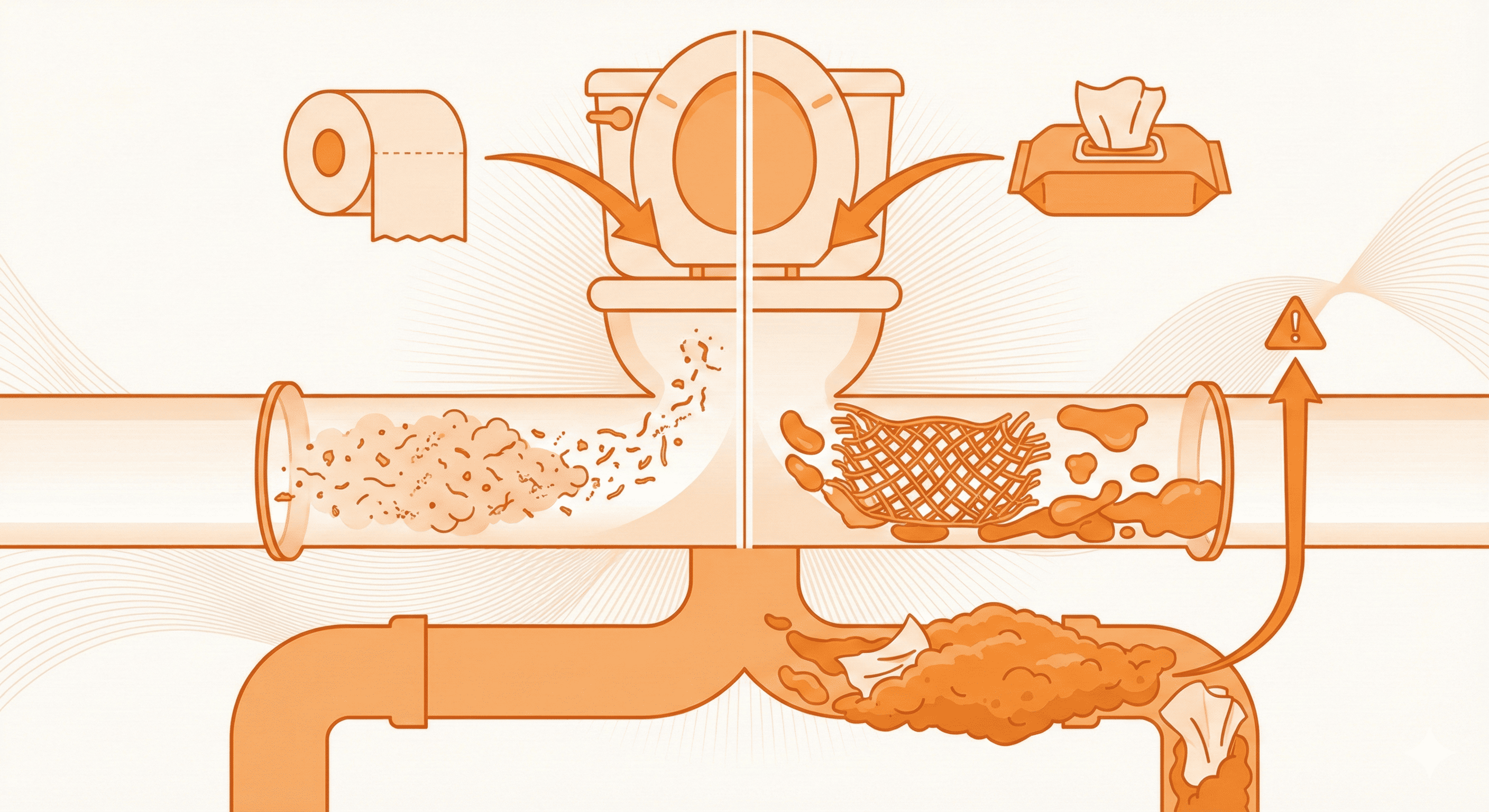
How Toilet Paper Dissolves (The Science of Cellulose)
Toilet paper is designed to fail. That is its main job. It is made from short natural fibers (cellulose) held together by weak chemical bonds.
The moment toilet paper hits water, those bonds loosen. Within seconds of flushing, the swirling water tears the paper into tiny, harmless clouds of fiber. By the time it reaches the city sewer main, it is practically a liquid.
Why “Flushable” Wipes Stay Intact
Wet wipes are designed for the opposite purpose: durability. They need to stay wet in the package without falling apart, and they need to hold up while you scrub.
To achieve this, manufacturers often use synthetic fibers or plastics woven into a strong mesh. They are built to survive water, not dissolve in it.
According to a report by the Town of Orono, wipes are designed to be durable, meaning they do not break down quickly—or at all—in the sewer system. While toilet paper disintegrates in seconds, a “flushable” wipe can remain intact for months, snagging on rough pipe edges and tree roots along the way.
Visual Note: If you put a square of toilet paper and a flushable wipe in two separate jars of water and shook them for 10 seconds, the toilet paper would be a cloudy mess. The wipe would look exactly the same as when it came out of the pack.
The “Fatberg” Effect: What Happens in Your Pipes
When flushable wipes enter the sewer system, they don’t just float harmlessly away. They combine with cooking grease and oil to create massive obstructions known as “fatbergs.”
Because the wipes don’t break down, they act as the structural reinforcement—like steel bars in concrete—for these clogs.
The scale of this issue is massive. Research indicates that wet wipes account for more than 90% of material causing sewer blockages, while toilet paper makes up less than 0.01%.
These blockages grow silently underground until they completely choke off the pipe, forcing raw sewage to back up into streets or, worse, into your basement.
The Hidden Cost of “Flushable”
You might pay a few extra dollars at the store for premium wipes, but the real cost comes later.
Municipalities across the US spend a fortune fighting these clogs. It is estimated that wipes cause over $1 billion in damage annually to utilities and pumps.
For you as a homeowner, the risk is personal. If a wipe snags on a root in your lateral line (the pipe connecting your house to the street), the resulting clog is your financial responsibility. A professional drain clearing can cost hundreds of dollars, while repairing a burst pipe can cost thousands.

Frequently Asked Questions (FAQ)
Are “flushable” wipes actually flushable?
Technically, yes—they will flush down the toilet. However, plumbing experts warn that “flushable” does not mean “dissolvable.” While they clear the bowl, they often get stuck in home pipes or municipal sewer lines because they do not break down like toilet paper.
Can I flush biodegradable wipes?
Most plumbers advise against it. While biodegradable wipes will eventually break down, they take weeks or months to do so. A toilet flush moves waste to the sewer in minutes. If the wipe hasn’t dissolved by then, it can still cause a blockage.
Is it safe to use flushable wipes with a septic tank?
No. Septic systems rely on bacteria to break down solids. Synthetic or heavily woven wipes do not decompose, meaning they accumulate in the tank. This fills the tank faster, requires more frequent pumping, and can clog the baffle, leading to expensive system failure.
What should I do if I accidentally flushed a wipe?
One wipe is unlikely to cause an immediate disaster. However, do not make it a habit. If you notice slow draining or gurgling sounds from your toilet, you may have a developing clog. For specific removal tips, check out this guide on how to dissolve flushable wipes before calling a professional plumber.
The Only Things You Should Flush
The evidence is clear: while the package says “flushable,” the plumbing reality says “risk.”
To protect your home’s pipes and the city sewer system, plumbing experts recommend following the “3 Ps” rule. You should only flush:
- Pee
- Poo
- Paper (Toilet paper only)
Everything else, including “flushable” wipes, paper towels, and hygiene products belongs in the trash can.
It might seem like a small inconvenience to toss a wipe in the bin instead of the bowl, but it is a choice that saves you money and keeps the water flowing. Don’t let a clean wipe lead to a messy disaster.
Disclaimer: This article is for informational purposes only and does not constitute professional plumbing advice. Always consult a licensed plumber for specific issues regarding your home’s plumbing system.
