
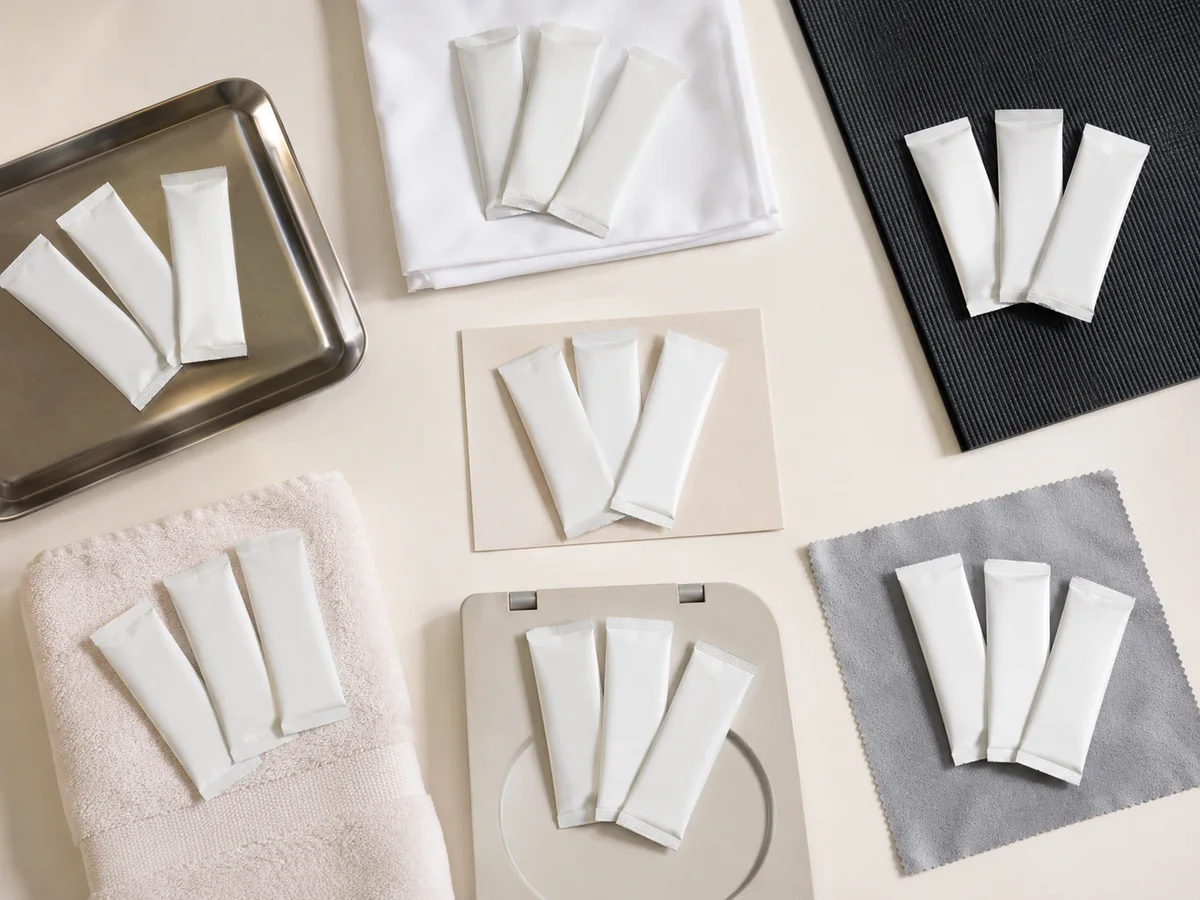
There is no single minimum order quantity for private label wipes. The minimum is set by the most expensive thing to start up in your project: usually the custom-printed packaging, then the lotion batch, the fabric and the number of SKUs. Change those choices and the minimum moves with them. This guide explains each factor, how pack format changes the picture, and the practical ways to start with a smaller first run.
Why there is no single MOQ
An MOQ protects the manufacturer from losing money on set-up. Every production run carries fixed work that does not depend on how many wipes are made: a lotion batch is mixed and released, a fabric is sourced and slit to width, packaging film is printed, the line is set up for that wipe size, fold and pack, and the first output is checked before the run continues. A minimum is simply the volume at which those fixed costs are spread thinly enough to make the run viable.
Because each component has its own set-up, the real minimum is set by whichever component is hardest to make in small quantities. That is why two quotes can show very different MOQs for products that look similar on the shelf. It is also why figures found online vary so widely, and why they are hard to compare: some are stated in packs, some in cases and some in individual wipes. When you compare minimums from different manufacturers, ask for them in the same unit, for the same pack format and print specification.
The factors that set the minimum
These are the components that most often determine a private label wipe’s minimum, why each one pushes the number up, and what usually brings it down.
| Factor | Why it raises the minimum | How to lower it |
|---|---|---|
| Printing | Printed film or sachet material is produced in its own runs, with plate or cylinder set-up for each design. Each artwork is a separate print job. | Use fewer designs, fewer colours or a shared design across scents; ask whether stock packaging with a printed label is an option for a pilot. |
| Lotion | A formula is mixed, tested and released as a batch. A batch is the smallest economical unit of lotion, and each formula needs its own. | Start from the manufacturer’s existing base formula and adjust it, rather than a fully new formulation. |
| Fabric | Nonwoven fabric is bought in rolls of a set width and weight. A special blend, weight or embossing may carry its own minimum from the fabric supplier. | Choose a substrate the manufacturer already runs for similar products. |
| Format | Each format, such as a single sachet, a resealable soft pack or a canister, runs on different tooling and has a different set-up. | Launch in one format first and add others once the product sells. |
| SKUs | Every SKU is a separate combination of formula, size, count and artwork, and each one has to reach a viable run on its own. | Launch with one or two hero SKUs instead of a full range. |
| Claim | Cosmetic, OTC drug and EPA-registered wipes carry different testing, documentation and release requirements, which are fixed costs per product. | Match the claim to what you actually need; see private label wet wipes regulations. |
| Cartons | Printed shipping cartons, retail display boxes and labels have their own print minimums. | Use plain shipping cartons with a printed label at first. |
In practice one or two of these factors decide the number. For most brands that is the printed packaging, because film is produced in long runs and every design starts its own job. The lotion batch decides it when the formula is new.

How pack format changes the minimum
The pack format affects the minimum more than most first-time buyers expect, because it changes both the packaging material and the way the line runs.
- Individually wrapped sachets. Each wipe is sealed in its own printed sachet. The printed sachet film is the main driver, so the number of designs matters a lot. Sachets suit sampling, travel, hospitality and gym programmes, where one wipe per use is the point.
- Resealable soft packs. A stack of folded wipes in a flow-wrapped pack with a reclosable label or lid. Count per pack, wipe size and the printed film determine the run.
- Canisters and tubs. A moulded container adds a separate component with its own supply minimum, plus a lid or dispensing insert.

Our guide to packaging types for private label wet wipes compares the formats in more detail.
Ways to start with a smaller first run
A brand testing a market usually wants the smallest run that still gives it a sellable, compliant product. These choices make the biggest difference:
- One SKU, one scent, one size. Range-building can wait until the first SKU has sales data.
- Start from a proven base formula. Adjusting fragrance, actives or claims on an existing base is faster and needs less batch volume than developing from scratch.
- Use a substrate the manufacturer already runs. A standard fabric avoids a separate fabric minimum.
- Keep the artwork simple. One design shared across a range, or fewer print colours, cuts print set-up.
- Pick a claim you can support without extra registration. A cleansing claim is quicker to bring to market than a germ-kill claim, which makes the wipe an OTC drug or an EPA-registered product.
- Agree the reorder plan up front. A first run sized to test the market is more useful when the same specification can be repeated without changes.
The trade-off between minimum and unit cost
A lower minimum is not free. Because set-up costs are spread over fewer units, the cost per wipe on a small first run is normally higher than on a large one. That is a reasonable trade for a brand testing a market: it limits the cash tied up in stock and the risk of being left with unsold inventory if the product needs changing.
The useful comparison is total landed cost for a run you can actually sell, not the lowest unit price at a volume you are not ready for. Freight, duties and longer lead times belong in that comparison when a quote comes from overseas, together with the cost of the working capital tied up in a larger order.
What happens after the first run
The first run proves the product: the lotion, the fabric, the saturation, the seal and the artwork all run together on the line. Once it sells, the decision is about scale. The cost of scaling depends on whether the product has to change. If the reorder repeats the same formula, fabric and pack, it is a straightforward repeat production. If moving to a larger run means switching supplier, formula or substrate, the product has to be sampled and approved again, and any stability or claim testing may need repeating.

That is why it pays to choose a manufacturer that can make both the first run and the scaled volume, so the product you tested is the product you scale.
How to get an accurate MOQ quote
A minimum can only be quoted against a specification. Including these details in your first enquiry gets you a real number instead of a range:
- Product type and intended use, and the claim you want to make.
- Wipe size and wipes per pack.
- Pack format: single sachet, soft pack, canister or tub.
- Formula direction: an existing base, an adjusted base or a custom formula, and any fragrance.
- Substrate preference, if you have one.
- Number of SKUs and artwork designs.
- Expected annual volume and your target launch date.
If some of these are not decided yet, send what you have. A good manufacturer will explain which choices move the minimum and by how much.
MOQ at Phoenix Wipes
Phoenix Wipes is a US private label manufacturer of wet wipes in Holbrook, New York, specialising in individually wrapped wipes in full-colour printed sachets. Our minimums are deliberately startup-friendly. We quote MOQ per formula and pack format rather than applying one number to everything, and we work with indie brands launching a single SKU as well as national retail programmes.
We quote formulation, materials and MOQ within days. You approve a physical sample of the wipe, lotion and printed sachet before production, and a short pilot run proves the line settings, seal and saturation. A first run is usually small enough to test a market, and the same formulation scales to national volume without requalifying the product. Converting, filling and quality control on every batch happen in-house.
Explore our private label wipes, including baby wipes and personal care wipes, see how our private label and sachet filling services work, or request an MOQ quote for your product.
Frequently asked questions
What is a typical MOQ for private label wipes?
There is no typical figure that holds across products. The minimum depends on the pack format, whether the packaging is custom-printed, the lotion batch and the number of SKUs. Ask each manufacturer for a minimum in the same unit and for the same specification so the quotes are comparable.
Can I order private label wipes in small quantities?
Yes, if the specification is kept simple: one SKU, a proven base formula, a standard substrate and simple artwork. Expect a higher unit cost on a small run, because set-up costs are spread over fewer wipes.
Does a custom formula raise the minimum?
Usually, because a new formula needs its own lotion batch, development and stability work. Adjusting an existing base formula is the common way to keep the minimum lower while still making the product your own.
Is the MOQ per SKU or per order?
Most minimums apply per SKU, because each formula, size and artwork combination runs separately. Some components, such as a shared base lotion or a shared substrate, can be pooled across SKUs. Ask how the manufacturer counts it.
Why do printed sachets affect the minimum so much?
Printed packaging film is produced in its own runs, with set-up for every design. The more designs and colours, the more film has to be ordered before the first wipe is packed.
How long does a first production run take?
Quoting is quick. Formulation and sampling are the variable part, because they depend on how much the product changes and how many sample rounds it needs. Once the artwork and the pilot run are approved, full production can be scheduled.
How this guide was put together: it explains the general production factors behind wipe minimums and describes Phoenix Wipes’ own approach as stated on our service and product pages. It gives no industry MOQ figures, because published figures are rarely comparable. Last reviewed: November 2026.
Discover more from Phoenix Wipes Inc.
Subscribe to get the latest posts sent to your email.