

Disinfectant contact time is how long a surface must stay visibly wet with the product for the label’s kill claim to hold. It is set by the product’s EPA registration and printed in the label directions, and it differs by product and by organism. For disinfecting wipes, the times listed for coronavirus claims on the EPA’s List N run from a few seconds to 10 minutes, and most are between 30 seconds and 4 minutes. If the surface dries before the time is up, it has not been disinfected to the claim on the label.
This guide explains what contact time means, what the EPA’s own data shows for disinfecting wipes, why wipes so often fall short of it in practice, and what a brand should think about before putting a contact time on its own disinfecting wipe.
What contact time means
Contact time, also called dwell time or wet time, is the period a disinfectant must remain on a surface to kill the organisms named on its label. The EPA puts it simply: the surface should be visibly wet for the entire contact time, and if it is not, more product should be applied (EPA, Selected EPA-Registered Disinfectants).
The time is not a recommendation. Disinfecting wipes are pesticides under federal law, and it is unlawful to use a registered pesticide “in a manner inconsistent with its labeling” (7 U.S.C. 136j). That is where the phrase “the label is the law” comes from. A wipe used for 20 seconds on a surface the label says must stay wet for 4 minutes has been used off-label, and the disinfection claim does not apply.
Contact time belongs to disinfecting and sanitizing claims. A wipe sold only to clean, or a cosmetic wipe for skin, has no contact time because it makes no claim to kill germs. Our guide to sanitizing vs disinfecting wipes explains how the claims differ and which agency regulates each.
What 80 disinfecting wipes on List N show
The EPA publishes contact times for every product on List N, its list of disinfectants for use against SARS-CoV-2, the virus that causes COVID-19. We downloaded the list and kept the products whose formulation type is a wipe: 80 products after removing one duplicate entry. The times below are the ones List N gives for each product’s coronavirus claim, either for SARS-CoV-2 itself or for the harder-to-kill virus whose directions the product follows.
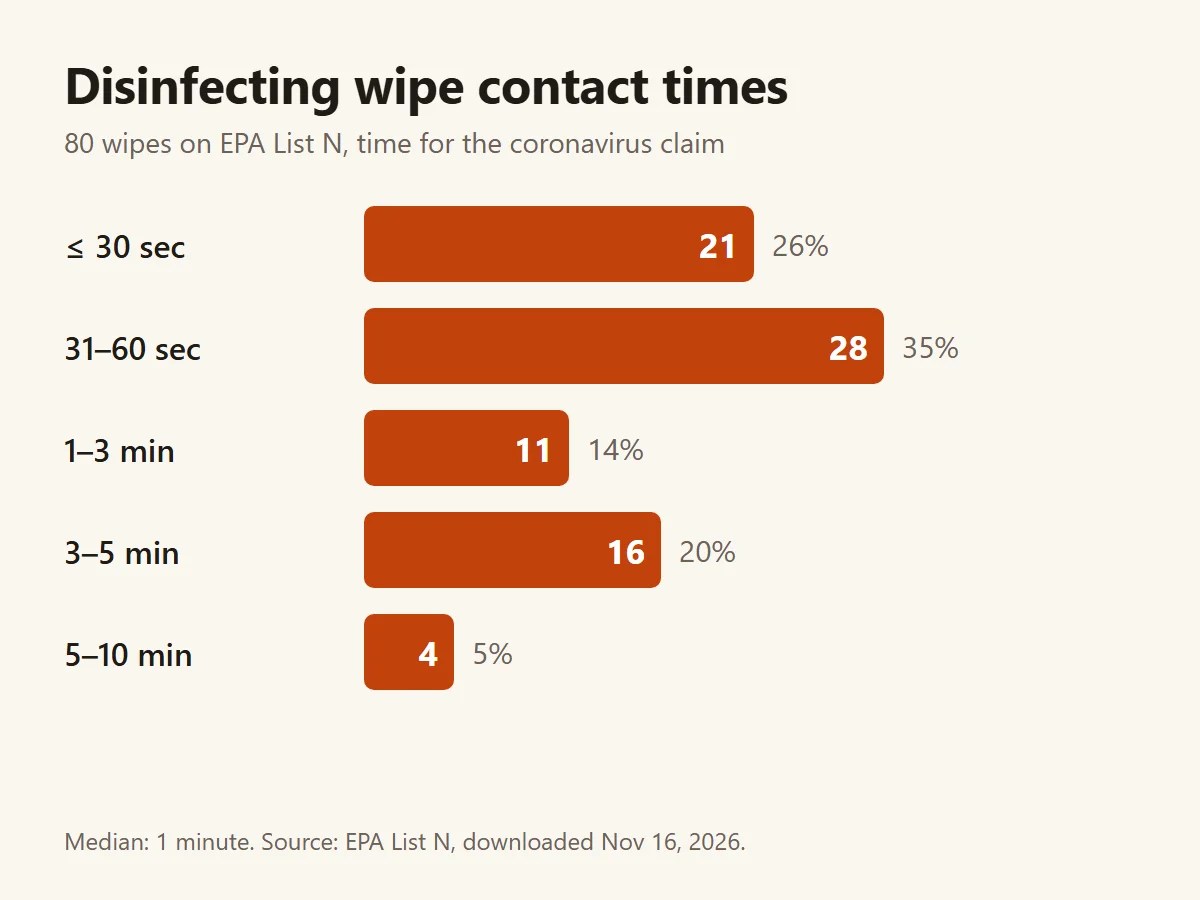
| Contact time for the coronavirus claim | Wipe products | Share |
|---|---|---|
| 30 seconds or less | 21 | 26% |
| 31 to 60 seconds | 28 | 35% |
| Over 1 minute, up to 3 minutes | 11 | 14% |
| Over 3 minutes, up to 5 minutes | 16 | 20% |
| Over 5 minutes, up to 10 minutes | 4 | 5% |
Three things stand out:
- The median is 1 minute. 49 of the 80 wipes, or 61%, list a time of 1 minute or less for their coronavirus claim.
- A quarter need 4 minutes or more. 20 wipes list 4 minutes or longer, and 3 list 10 minutes. Two products that look alike on a shelf can ask for very different behaviour from the person using them.
- Most fall between 30 seconds and 4 minutes. 57 of the 80, or 71%, sit in that range.
The active ingredient explains part of the spread. Among the groups with at least seven products:
| Active ingredient | Wipes | Median time | Range |
|---|---|---|---|
| Quaternary ammonium (quat) only | 28 | 2 min 45 s | 15 s to 10 min |
| Quat with alcohol | 15 | 1 min | 6 s to 10 min |
| Hydrogen peroxide | 12 | 1 min | 15 s to 6 min |
| Sodium hypochlorite (bleach) | 11 | 1 min | 30 s to 1 min |
| Citric acid | 7 | 30 s | 15 s to 5 min |
The ranges overlap widely, so the active alone does not tell you the time. Concentration, the rest of the formula and the claim the company chose to test all matter. The only reliable source is the label of the product in your hand.
One caution about these numbers. They are the times for one claim. The same wipe usually carries other claims, against bacteria, fungi or other viruses, and each can have its own time. A wipe that kills the coronavirus in 1 minute may need longer for a bacterium on the same label. Read the directions for the organism you are worried about, not the shortest number on the pack.
Why wipes so often miss the contact time
A spray can be reapplied in a second. A wipe has to carry all the liquid it will leave behind, so it is the format most likely to let a surface dry too early. The usual causes are practical:
- Too much surface per wipe. A wipe spreads a fixed amount of liquid. Stretched over a whole desk or a full weight bench, the film becomes too thin to stay wet.
- A dried-out pack. A canister left open or a pack with a poor reseal loses liquid, and the last wipes carry far less than the first.
- Fast drying conditions. Warm rooms, air movement and absorbent surfaces shorten the time a film stays wet.
- Wiping dry too soon. Staff or members wipe the surface dry with a towel straight away, which ends the contact time before it starts.
- Soil left on the surface. Many labels require heavily soiled surfaces to be cleaned first, because dirt and body fluids get in the way of the disinfectant.

How to meet the contact time in practice
The fix is a routine, not a product swap:
- Read the time for the organism you care about and post it where the wipes are used, in seconds or minutes, not as “let air dry”.
- Clean first when the surface is visibly dirty, then disinfect with a fresh wipe, if the label calls for it.
- Use enough wipes to keep the area wet. Work in smaller sections and take a new wipe when the one in your hand stops leaving a visible film.
- Check at the end of the time. If the surface is dry before the time is up, reapply.
- Close the pack after each use so the last wipe carries as much liquid as the first.
The pressure points are different in each setting:
- Gyms have the hardest case: members wipe equipment between sets, and the next person is already waiting. A short contact time and a clear sign by the dispenser help more than anything else. See our page on gym and fitness wipes.
- Hotels disinfect many high-touch points per room under time pressure, so the contact time needs to be built into the room cleaning sequence. See hospitality wipes.
- Healthcare and care facilities follow their infection prevention policy, which names the product and its contact time. See healthcare wipes.

What contact time means for a brand making its own wipe
If you are launching a private label disinfecting wipe, the contact time is one of the first decisions, not a detail for the label designer:
- It comes with the registration. A disinfecting wipe needs an EPA-registered formula, and the contact times on the label are the ones supported by that registration’s efficacy data. A brand cannot shorten the time on its own label.
- It should fit how the wipe will be used. A 4-minute claim may suit a clinic with a written procedure but not a gym where members wipe and walk away.
- The wipe has to deliver it. The fabric, the wipe size and the amount of liquid in each wipe decide how much surface one wipe can keep wet. A pack format that reseals well protects that liquid until the last wipe.
- Some claims are sanitizing, not disinfecting. A sanitizing claim reduces bacteria rather than killing the full list of organisms, and it has its own times and tests.
Our surface disinfecting wipes page covers the product side, and the wet wipes glossary defines the terms used here.
Disinfecting wipes at Phoenix Wipes
Phoenix Wipes is a US private label manufacturer of wet wipes in Holbrook, New York, with converting, filling and QC on every batch in-house at our New York facility. Healthcare and antiseptic products are made to the applicable FDA OTC monograph, and disinfecting claims are handled against the relevant registration route. Tell us the claim you need to make and we will tell you what the product has to meet, or contact us about your wipe.
Frequently asked questions
What is the contact time for disinfecting wipes?
It depends on the product and the organism. For the coronavirus claims of 80 disinfecting wipes on the EPA’s List N, times run from a few seconds to 10 minutes, with a median of 1 minute. Other organisms on the same label can have different times, so check the directions for the one you need.
Is dwell time the same as contact time?
Yes. Contact time, dwell time and wet time all mean the period a disinfectant must stay on the surface, visibly wet, to work as the label claims.
What happens if the surface dries before the contact time?
The surface has not been disinfected to the label claim. The EPA says to apply more product so the surface stays visibly wet for the full time.
Do I need to wipe the surface dry afterwards?
Follow the label. Many disinfecting wipes are left to air dry, and food contact surfaces may need a rinse, depending on the product’s directions.
Why do some disinfecting wipes take 10 minutes?
The time reflects the efficacy testing behind the claim. A formula tested against a hard-to-kill organism, or at a lower concentration, may need longer. A shorter time is a property of the specific registered formula, not of wipes in general.
Do baby wipes or cleansing wipes have a contact time?
No. Cosmetic and cleaning wipes make no claim to kill germs, so they have no contact time. Only sanitizing and disinfecting products registered with the EPA carry one.
How this guide was put together: contact times come from the EPA’s List N data, downloaded on November 16, 2026, filtered to products with the formulation type “wipe” (81 entries, 80 products after removing a duplicate). The times are the ones List N gives for each product’s coronavirus claim; we report totals only, not individual products. Legal references link to the US Code. Last reviewed: November 2026.
Discover more from Phoenix Wipes Inc.
Subscribe to get the latest posts sent to your email.