
Private Label · Dental
Dog Dental Wipes
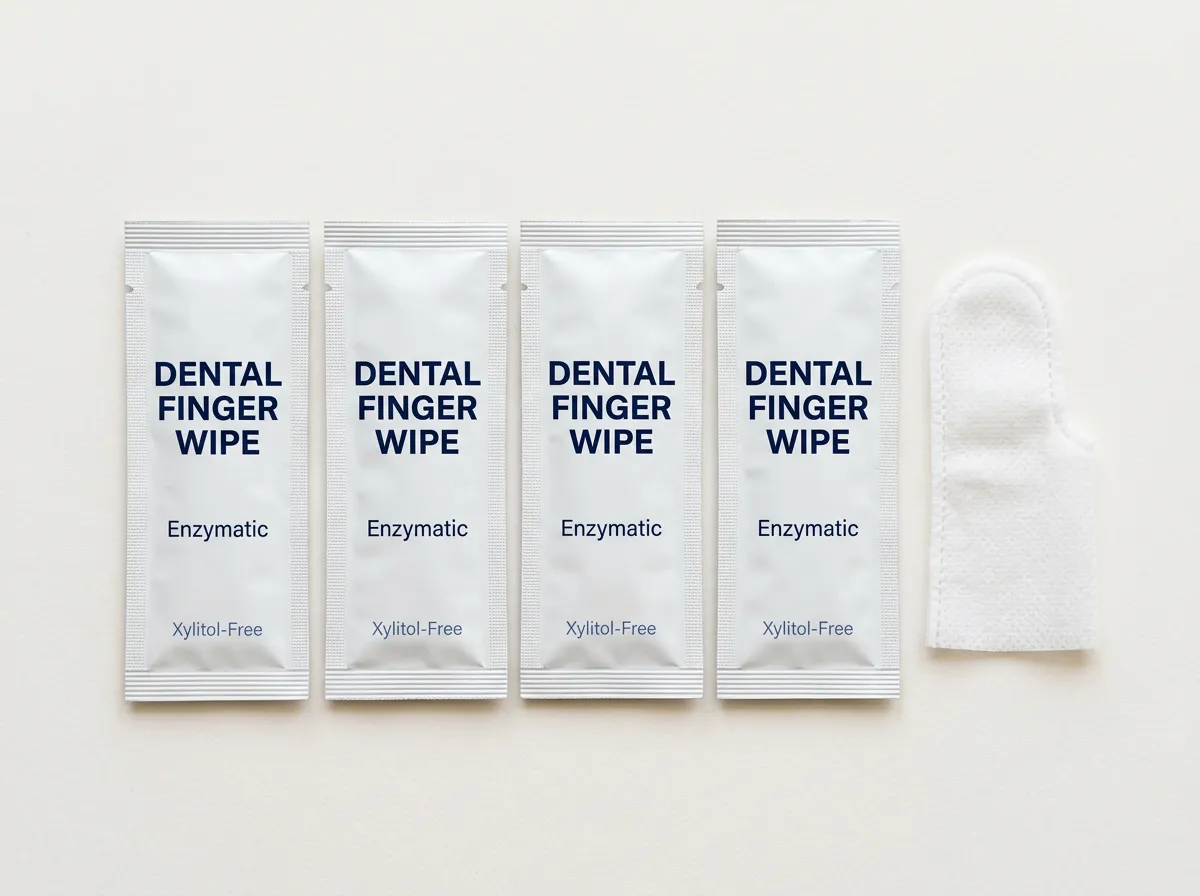
We manufacture private label dog dental wipes with real enzymatic chemistry on a textured finger format — the realistic option for the very large number of owners who will never successfully use a toothbrush. Xylitol-free, made in the USA.
ENZYMATIC · XYLITOL-FREE · FINGER FORMAT · MADE IN THE USA
System
Enzymatic + mechanical texture
Format
Finger wipe or mitt
Xylitol
Excluded absolutely
Shelf life
24–30 months
How it works
How often you actually need to brush a dog’s teeth
Daily, and the reason is a clock rather than a preference. Plaque mineralises into tartar in roughly two to three days, so anything less frequent than every second day lets part of each cycle harden past the point where any home product can remove it. If daily is unrealistic — and in most households it is — every other day captures most of the benefit and three times a week is still meaningfully better than nothing. The weekly clean that most owners actually manage is the one interval that does very little, because by then the target has already turned to tartar. Work the outer surfaces of the upper back teeth first: that is where tartar accumulates fastest and where the gum line inflames earliest. Thirty seconds a side is enough.
Periodontal disease is the most common diagnosed condition in adult dogs — by some estimates the majority of dogs over three show signs of it. The mechanism is a clock: soft plaque forms on the tooth surface within hours of eating, and if it is not disrupted it mineralises into tartar within roughly two to three days. Tartar cannot be wiped, brushed or chewed off; it requires scaling under anaesthetic. Everything a home dental product does is about intervening inside that three-day window.
Our formulation combines two mechanisms. Enzymatic — typically a glucose oxidase and lactoperoxidase system that generates antibacterial activity in the mouth and helps break down the plaque biofilm. And mechanical — a textured substrate that physically disrupts plaque at the tooth surface and, critically, along the gum line where periodontal disease actually starts. Neither alone is as effective as both together, and a smooth wipe with a pleasant flavour is close to useless.
The finger format is the honest recognition of how this product is used. Most owners do not brush their dog’s teeth, and telling them to try harder does not change the outcome. A wipe over the finger gives tactile feedback, reaches the outer surfaces of the molars where plaque accumulates most, and is tolerated by many dogs that will not accept a brush. And one absolute exclusion: no xylitol. It appears in human oral products as a sweetener and anti-cariogenic agent and is severely toxic to dogs. Any dental product for pets must be xylitol-free, and it should say so on the front of the pack.
At a glance
✓Enzymatic system (glucose oxidase / lactoperoxidase)
✓Textured substrate for mechanical plaque disruption
✓Finger format for gum-line and molar access
✓Xylitol-free — stated on the front of the pack
✓Daily use inside the 2–3 day plaque window
Cannot remove existing tartar. Mineralised tartar needs veterinary scaling — say so rather than implying otherwise.
Applications
Where dog dental wipes sell
A large, well-documented health problem with an unusually clear educational story — and a product that fits how owners actually behave.
01
Owners who cannot brush
The primary market, and it is enormous. A wipe that gets used daily beats a toothbrush that stays in the drawer.
02
Bad breath complaints
Halitosis is what actually brings owners to the category. It is also an early signal of periodontal disease, which makes it a legitimate hook rather than a purely cosmetic one.
03
Small & toy breeds
Crowded dentition means faster plaque accumulation and higher periodontal risk. Toy-breed owners are the most receptive audience.
04
Post-dental-cleaning maintenance
After a veterinary scale and polish, owners are motivated and have just paid for an anaesthetic — the single best moment to sell a maintenance product.
05
Senior dog care
Older dogs where anaesthesia carries more risk, so preventive home care becomes proportionally more valuable.
06
Veterinary & dental-month retail
Clinics run pet dental health campaigns annually; a well-positioned wipe rides that promotion every year.
Specifications
Dog dental wipe specifications
Both mechanisms need specifying — the enzyme system and the substrate texture do different halves of the job.
| Enzymatic system | Glucose oxidase / lactoperoxidase |
|---|---|
| Mechanical action | Textured or micro-abrasive substrate surface |
| Xylitol | Excluded absolutely |
| Also excluded | Alcohol, fluoride, human toothpaste actives |
| Flavour | Pet-palatable (poultry, mint-free options) |
| Format | Finger wipe, finger mitt, or flat pad |
| Substrate | Textured nonwoven 55–70 gsm |
| Standard sizes | 2″ × 3″ finger pad · mitt · 4″ × 4″ flat |
| Saturation | 2–4 g per unit |
| Frequency | Daily — within the 2–3 day plaque mineralisation window |
| Claim boundary | Plaque and breath; not tartar removal |
| Shelf life | 24–30 months unopened |
Packaging formats
- Canister50 / 100 finger wipes
- Finger mitt30 / 50 mitts
- Softpack40 wipes
- Single sachet1 wipe, travel
- Vet cartonBulk, post-dental retail
- Dental kitCo-packed with chews
Put xylitol-free on the front panel, not in the ingredient list. It is the one thing an informed dog owner actively checks for in an oral product, and leading with it converts.
Comparison
Dental, ear or eye wipes?
Three targeted-hygiene SKUs. Dental is the one with the clearest documented health benefit.
| Product | Key actives | Applied to | Frequency | Best for |
|---|---|---|---|---|
| Dog Ear Wipes | Drying agents, mild acidifier | Outer ear and pinna only | Weekly or per vet | Wax, moisture and odour in the outer ear |
| Dog Eye & Tear-Stain Wipes | Ultra-mild, tear-free, no bleach | Around the eye, tear tracks | Daily | Discharge and tear staining on light coats |
| Dog Dental WipesThis page | Enzymatic, textured finger format | Teeth and gum line | Daily | Plaque and breath between brushing |

Private Label & OEM
The realistic dental product
Veterinary advice is to brush daily; the reality is that most owners never manage it. A dental wipe that is used four times a week delivers more real benefit than a toothbrush used twice a year. Build it with a genuine enzyme system and a textured surface, put xylitol-free on the front, and be honest that it does not remove existing tartar — that combination sells in clinics.
✓Genuine enzymatic system, not flavour alone
✓Textured substrate for gum-line plaque disruption
✓Finger and mitt formats for real-world access
✓Xylitol-free flagged on the front panel
✓Claim language reviewed against veterinary expectations
FAQ
Dog dental wipes FAQ
Do dog dental wipes actually work?
For plaque and breath, yes — provided they are used often enough and have both mechanisms. Plaque mineralises into tartar in roughly two to three days, so daily or near-daily disruption inside that window is what produces the benefit. A wipe with an enzyme system and a textured surface used four times a week does considerably more than a toothbrush used twice a year.
Can dental wipes remove tartar?
No, and any product claiming otherwise is overclaiming. Once plaque mineralises into tartar it is bonded to the tooth and requires veterinary scaling, usually under anaesthetic. Wipes work on soft plaque before it hardens. Stating that clearly is what earns clinic recommendations.
Are dental wipes better than brushing?
Brushing is more effective in principle. Wipes are more effective in practice for the large majority of owners who will not or cannot brush — and many dogs that resist a brush will tolerate a finger. The best dental product is the one that actually gets used daily.
Why must dog dental products be xylitol-free?
Because xylitol is severely toxic to dogs, causing a rapid insulin release, dangerous hypoglycaemia and potentially liver failure. It is common in human oral-care products as a sweetener and anti-cariogenic agent, which makes cross-contamination of formulation thinking a real risk. Every pet dental product must be xylitol-free, and we put that claim on the front of the pack.
How do enzymatic dental wipes work?
Typically through a glucose oxidase and lactoperoxidase system that produces antibacterial activity in the mouth and helps break down the plaque biofilm, making it easier to disrupt mechanically. The enzymes complement the texture of the substrate rather than replacing it — you want both.
When is the best time to sell a dental wipe?
Immediately after a veterinary scale and polish. The owner has just paid for an anaesthetic procedure, has been told about periodontal disease by a vet, and is more motivated than they will be at any other point. Clinics know this, which is why post-dental retail is the strongest channel in the category.
Other pet wipes we make
Dental completes the targeted-care trio and pairs well with everyday products.
Ear Care
Dog Ear Wipes
Outer-ear maintenance with drying agents and a mild acidifier.
View details →
Eye Care
Dog Eye & Tear-Stain Wipes
Tear-free wipes for discharge and porphyrin tear staining.
View details →
Everyday
Dog & Cat Cleaning Wipes
The everyday body and face wipe at pet-appropriate pH.
View details →
Launch an enzymatic dental wipe
Real enzyme system, textured substrate, xylitol-free, honest claims. Made in the USA.