
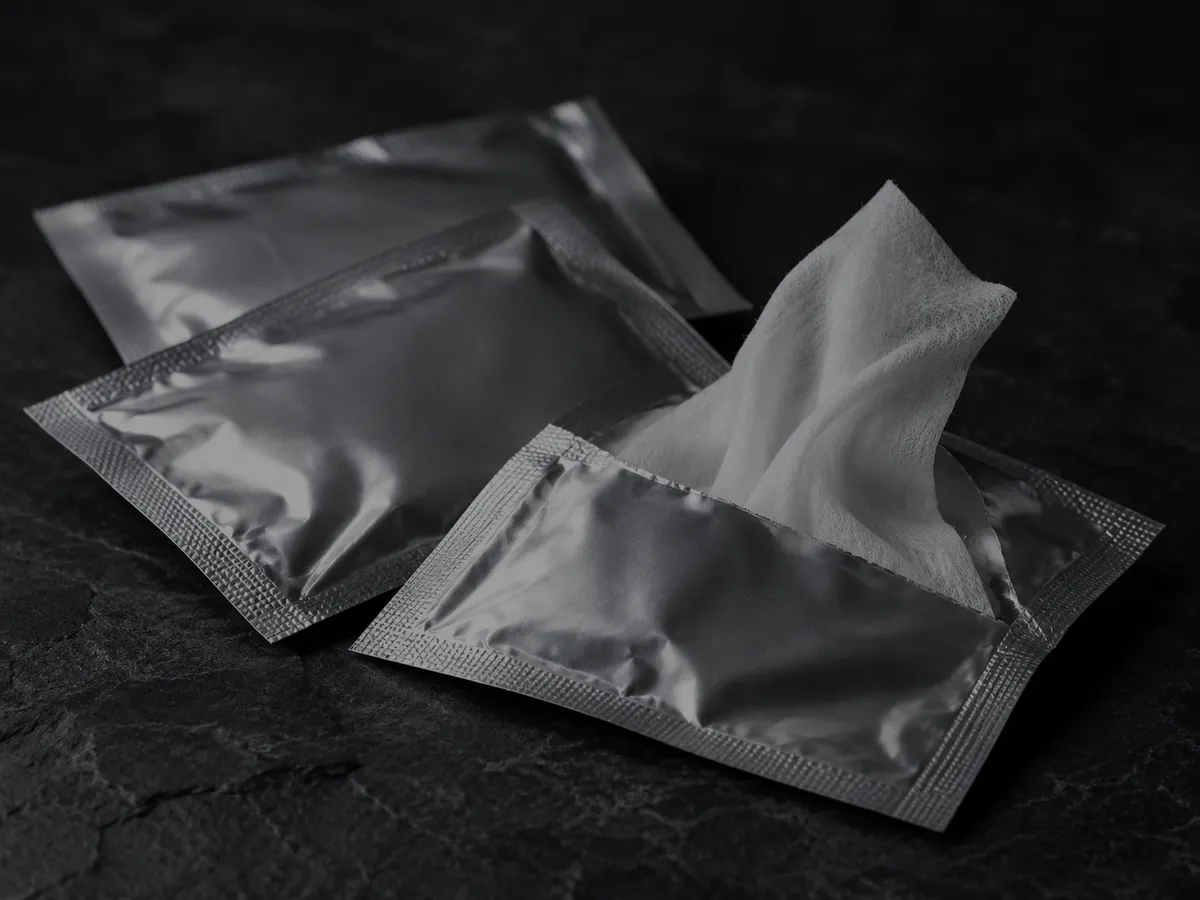
No. Hand sanitizer and antiseptic wipes are not FDA approved, but they are over-the-counter (OTC) drugs, and they have to meet the FDA’s drug rules. A wipe that claims to kill germs on skin can be sold without an approved application if it follows the conditions the FDA has set for its active ingredient, such as ethyl alcohol at 60 to 95%. In return it carries obligations a cosmetic wipe does not: a Drug Facts panel, manufacture under drug cGMP in a registered establishment, a drug listing with a National Drug Code (NDC), an adverse event contact on the label and, for the facility, an annual FDA user fee.
This guide explains which rules apply to which kind of skin antiseptic wipe, how the Drug Facts panel works on a small sachet, and who registers, lists and owns the NDC when the wipe is made for your brand. Everything here is taken from the statute, the Code of Federal Regulations and FDA notices, which are linked throughout.
Why a hand wipe can be a drug
The claim decides the regulator, not the formula:
- Kills germs on skin, for example “hand sanitizer to help reduce bacteria on the skin”: an OTC drug, regulated by the FDA.
- Kills germs on surfaces: a pesticide, regulated by the EPA. See our guide to EPA registration for disinfecting wipes.
- Cleans and refreshes, with no germ claim: usually a cosmetic.
The same wet wipe can fall into any of the three depending on what the pack says. Our comparison of sanitizing vs disinfecting wipes covers the claim boundaries in more detail.
“FDA approved” vs the monograph route
Most OTC drugs are not approved one by one. Since the CARES Act of 2020, section 505G of the Food, Drug, and Cosmetic Act (21 U.S.C. 355h) governs them through OTC monographs: standards that set the allowed active ingredients, strengths, labeling and tests for a product category. The FDA’s monograph pages put it plainly: a product that conforms “can be legally marketed without an FDA approved application” (OTC Monographs@FDA).
Hand sanitizers sit in a less settled corner of that system. In its 2019 final rule on consumer antiseptic rubs, which expressly covers consumer antiseptic wipes as well as gels and liquids, the FDA deferred its decision on three active ingredients: ethyl alcohol, isopropyl alcohol and benzalkonium chloride. Those three were never finalized, so they were not turned into final orders by the CARES Act. They fall under a separate provision, section 505G(a)(3), and in its guidance for small businesses the FDA explains that such products are not required to have an approved application as long as they conform to the conditions of use in the applicable tentative final monograph.
In practice:
- Do not put “FDA approved” or “FDA registered product” on the pack or in marketing. Neither is true of a monograph-route wipe.
- “Conforms to the applicable FDA conditions for OTC hand sanitizers” is an accurate internal description. It is not a claim to print.
- The conditions can change. The FDA can still issue an order that finalizes or removes any of the three deferred ingredients, so keep an eye on it.
Which rules cover which antiseptic wipe
“Antiseptic wipe” covers several FDA categories, each with its own rule and its own list of active ingredients:
| Wipe | FDA category | Where the rules sit | Active ingredients and strength |
|---|---|---|---|
| Hand sanitizer wipe for consumers | Consumer antiseptic rub | 2019 final rule; three actives deferred under 505G(a)(3) | Ethyl alcohol 60–95%; isopropyl alcohol 70–91.3%; benzalkonium chloride (deferred; confirm the strength against the applicable conditions) |
| Alcohol prep pad and preinjection skin prep | Health care antiseptic (patient preinjection skin preparation) | 2017 final rule; six actives deferred | Includes ethyl alcohol, isopropyl alcohol and povidone-iodine, among the deferred actives |
| Povidone-iodine wipe for skin prep | Health care antiseptic | 2017 final rule; deferred active | Povidone-iodine |
| First aid antiseptic towelette | First aid antiseptic | Monograph M003, a final order | Includes benzalkonium chloride 0.1–0.13%, alcohol 48–95% and isopropyl alcohol 50–91.3%, for minor cuts, scrapes and burns |
| Antibacterial wash used with water | Consumer antiseptic wash | 2016 final rule | 19 actives, including triclosan and triclocarban, found not generally recognized as safe and effective |
Two points that trip brands up. First, the category follows the intended use: the same 70% isopropyl alcohol pad is a health care antiseptic when sold for skin prep before an injection, and a consumer antiseptic rub when sold as a hand sanitizer. Second, not every antiseptic has a monograph route at all. Chlorhexidine gluconate, for example, was found ineligible for the health care antiseptic monograph, and the FDA’s 2017 rule states that these products require an approved new drug application (NDA or ANDA) before marketing.

The Drug Facts panel on a wipe
Every OTC drug wipe carries a Drug Facts panel laid out under 21 CFR 201.66. The headings must appear in this order:
- Drug Facts (the title)
- Active ingredient, with its strength
- Purpose, for example “Antiseptic”
- Uses
- Warnings, including flammability for alcohol products
- Directions
- Other information, such as storage temperature
- Inactive ingredients
- Questions? with a phone number (optional)
Three details matter for wipes:
- Where the panel goes. Drug Facts belongs on the outside container or wrapper of the retail package, or on the immediate container when there is no outer package. For single sachets sold in a carton, that means the carton. A sachet sold or handed out on its own carries the panel itself.
- Strength as a proportion. Topical products state the active as a proportion, such as “Ethyl alcohol 70% v/v”, not as a quantity per wipe.
- Small packs. Where the full format would take up more than 60% of the surface available for labeling, paragraph (d)(10) allows a reduced format. Headings can drop to 7 point, or 1 point larger than the text. Line spacing can be tighter, bullets need not line up, and colour contrast can replace the box. The barlines and hairlines between sections still apply.

Label text for each category follows the applicable conditions, including the wording of uses and warnings. Write it from those conditions, not by copying another brand’s pack.
Who registers, who lists, and whose NDC it is
This is where private label wipes differ from a manufacturer’s own brand. The rules are in 21 CFR Part 207:
| Obligation | Who | Rule |
|---|---|---|
| Register the establishment with the FDA | The manufacturer, and any repacker or relabeler, for each establishment | 207.17(a) |
| Register as a brand owner | Not required for a private label distributor that does not also manufacture, repack or relabel | 207.17(b) |
| Obtain an NDC labeler code | The private label distributor applies for its own | 207.33(c)(1) |
| List the drug | The manufacturer lists it under the brand’s labeler code, and also under its own | 207.41(c) |
Part 207 defines a private label distributor as a company that does not make the drug but under whose label or trade name it is sold. So when a brand sells hand sanitizer wipes under its own name, the NDC on the pack normally begins with the brand’s labeler code, and the manufacturer submits the listing.
Today an NDC has 10 or 11 digits in three segments: labeler code, product code and package code. The FDA has finalized a move to a single 12-digit format, but the rule is not effective until March 7, 2033, with a transition period for labels after that. Packaging printed today uses the current format.
cGMP and the facility fee
A monograph product only qualifies if it is made under the drug cGMP rules in 21 CFR Parts 210 and 211, in a registered establishment, and listed under Part 207 (21 CFR 330.1). Drug cGMP is stricter than cosmetic practice. It covers testing of incoming actives, batch records, release testing, stability data to support the expiry date, and complaint handling.
The CARES Act also created OTC monograph user fees, known as OMUFA. Each facility that makes a monograph drug pays an annual facility fee. A contract manufacturing organization, meaning a facility whose owner does not sell the finished drug directly to wholesalers, retailers or consumers, pays two-thirds of the full fee. For fiscal year 2027 the FDA set the fees at $47,891 for a monograph drug facility and $31,927 for a contract manufacturing facility. The fiscal 2026 fees were much lower, at $19,188 and $12,792, because the FDA reduced them to draw down a reserve. The amounts are reset every year, so budget from the current notice. A drug made in a facility whose fees have not been paid is treated as misbranded under 21 U.S.C. 352.
The adverse event contact on the label
The label of a nonprescription drug must include a domestic address or domestic phone number through which the responsible person can receive reports of serious adverse events (21 U.S.C. 352(x)). The responsible person is the manufacturer, packer or distributor whose name appears on the label, which for a private label wipe is usually the brand. Serious adverse event reports must be passed to the FDA within 15 business days of receipt (21 U.S.C. 379aa). Agree before launch who answers that number and how reports reach the manufacturer.
A launch checklist for hand sanitizer and antiseptic wipes
- Fix the claim first. Skin, surface or cleansing only. That decides FDA, EPA or cosmetic.
- Confirm the category and active. Consumer hand sanitizer, health care antiseptic or first aid antiseptic, and an allowed active at an allowed strength.
- Get your labeler code if you will be the brand on the pack.
- Ask the manufacturer to confirm its establishment registration, how it will list your product under your labeler code, and its cGMP and stability programme for the expiry date you want to print.
- Build the Drug Facts panel from the applicable conditions, on the carton or on the sachet if it is sold alone.
- Set up the adverse event contact and the route for reports between you and the manufacturer.
- Check the marketing copy: no “FDA approved”, and no claims beyond what the category allows.
Our overview of private label wet wipes regulations covers the cosmetic and EPA sides, and the quote checklist lists what to send a manufacturer.
Antiseptic wipes at Phoenix Wipes
Phoenix Wipes is a US private label manufacturer of wet wipes in Holbrook, New York. Healthcare and antiseptic products are made to the applicable FDA OTC monograph, and disinfecting claims are handled against the relevant registration route. Tell us the claim you need to make and we will tell you what the product has to meet. Contact us to start.
Frequently asked questions
Are hand sanitizer wipes FDA approved?
No. They are OTC drugs sold without an approved application, on condition that they follow the FDA’s conditions for their active ingredient. Saying “FDA approved” on the pack would be misleading.
Do hand sanitizer wipes need an NDC?
Yes. As OTC drugs they must be listed with the FDA, and each listed product and package has a National Drug Code.
Who owns the NDC on a private label wipe?
Usually the brand. A private label distributor applies for its own labeler code, and the manufacturer lists the product under that code as well as under its own.
Does a brand selling hand sanitizer wipes need to register with the FDA?
Not as an establishment, if it only distributes under its own label and does not make, repack or relabel the product. The manufacturing establishment registers.
What alcohol percentage do hand sanitizer wipes need?
Under the conditions for consumer hand sanitizers, ethyl alcohol from 60 to 95% or isopropyl alcohol from 70 to 91.3%.
Is a hand sanitizer wipe the same as a disinfecting wipe?
No. A hand sanitizer wipe is for skin and is regulated by the FDA as a drug. A disinfecting wipe is for surfaces and is regulated by the EPA as a pesticide.
How this guide was put together: the rules are taken from 21 U.S.C. 352, 355h and 379aa, 21 CFR Parts 201, 207 and 330, the FDA’s 2016, 2017 and 2019 antiseptic final rules, its 2020 small-business guidance, and the fiscal 2026 and 2027 OMUFA fee notices. This is general information, not legal advice. Last reviewed: November 2026.
Discover more from Phoenix Wipes Inc.
Subscribe to get the latest posts sent to your email.