

GSM on a wet wipe means grams per square metre: the weight of the dry fabric before any lotion is added. It is the standard way to state how much material is in a wipe. Most wet wipes fall between 40 and 80 gsm. Lens and screen wipes sit at the light end, around 30 gsm. Baby and facial wipes usually run 45 to 75 gsm. Heavy-duty floor, car wash and hot towel wipes reach 90 to 100 gsm. A higher number means more fabric, more thickness and more room for lotion. It does not, on its own, mean a stronger or softer wipe.
This guide explains what GSM measures, how to turn it into a weight per wipe, which ranges are common for each type of wipe, and how to use it in a specification.
What GSM measures, and what it does not
GSM is the basis weight, or mass per unit area, of the nonwoven fabric. It is measured by cutting a specimen of known area from the fabric, weighing it and dividing the weight by the area. The method for nonwovens is set out in the international standard ISO 9073-1:2023, Nonwovens: Determination of mass per unit area. In the US you will sometimes see ounces per square yard instead. One oz/yd² is about 33.9 gsm, so a 1.5 oz/yd² fabric is about 51 gsm.
What GSM does not tell you:
- Thickness and feel. Two 50 gsm fabrics can feel quite different. A high-loft or embossed fabric feels thicker than a flat one of the same weight.
- Strength. Wet strength depends mainly on the fibre blend and how the fabric is bonded. Polyester holds its strength when wet, and a viscose-only fabric loses much of its strength once saturated.
- The lotion. GSM is a dry fabric figure. How much liquid each wipe carries, the lotion load, is a separate specification.
Our guide to spunlace vs spunbond vs airlaid covers how bonding and fibre choice change a fabric.
From GSM to the weight of one wipe
Multiply the GSM by the wipe’s area in square metres to get the dry fabric weight of a single wipe:
| Wipe size | Area | 40 gsm | 50 gsm | 60 gsm | 80 gsm |
|---|---|---|---|---|---|
| 15 × 20 cm (about 6 × 8 in) | 0.030 m² | 1.2 g | 1.5 g | 1.8 g | 2.4 g |
| 20 × 20 cm (about 8 × 8 in) | 0.040 m² | 1.6 g | 2.0 g | 2.4 g | 3.2 g |
| 20 × 30 cm (about 8 × 12 in) | 0.060 m² | 2.4 g | 3.0 g | 3.6 g | 4.8 g |
This is useful in two ways. It lets you compare quotes that state different sizes and weights. It also lets you check a supplier’s figure: cut a 10 × 10 cm square (0.01 m²) of dry fabric, weigh it, and multiply by 100 to get GSM. Measure dry roll stock or unsaturated wipes. A dried finished wipe still carries lotion solids, so it will read slightly heavy.

Typical GSM by type of wipe
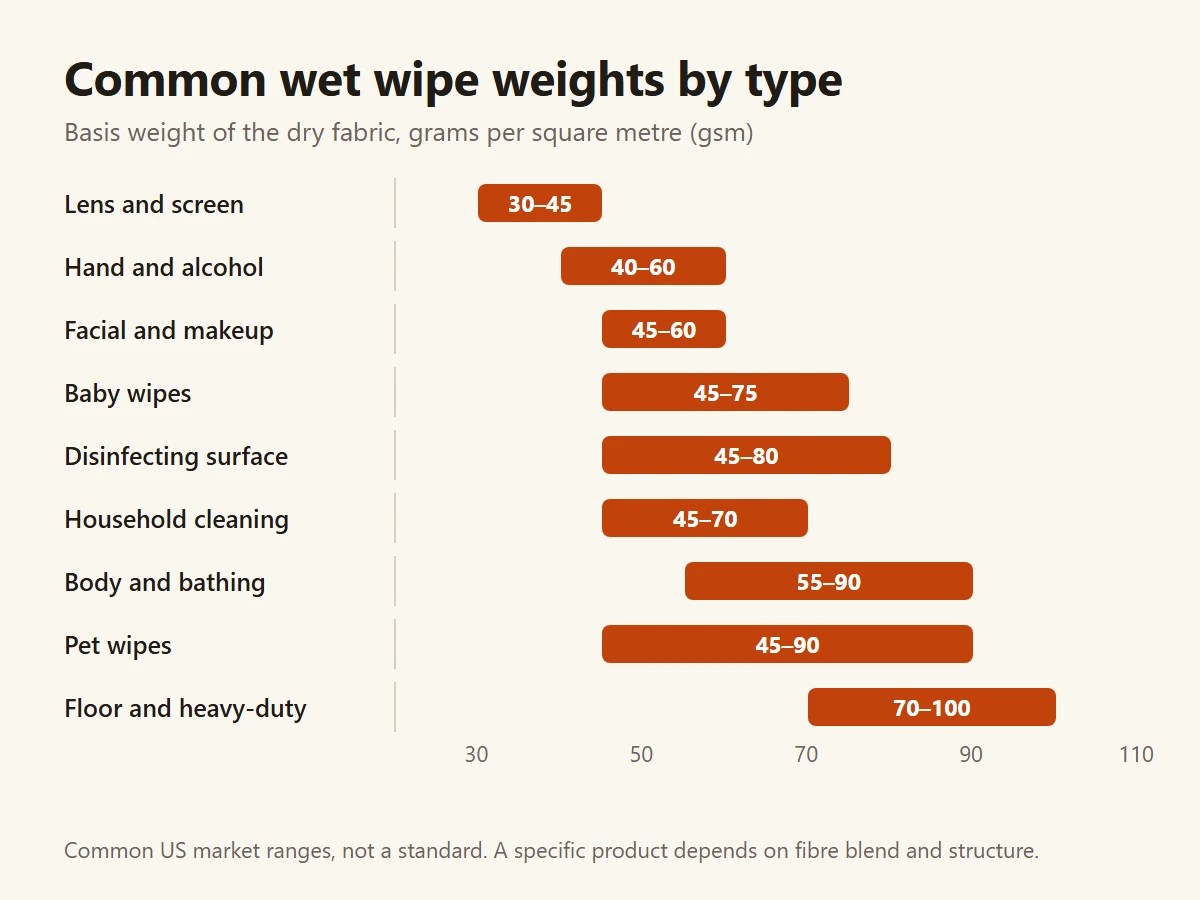
There is no industry standard that sets a GSM for each wipe. The ranges below are common in the US market. Each row links to the matching product page, where you can see where a specific product sits.
| Type of wipe | Common range | Why |
|---|---|---|
| Lens, screen and electronics | 30–45 gsm | Thin, low-lint and quick to dry. Capacity matters less than leaving nothing behind. See lens wipes. |
| Hand, refreshing and alcohol wipes | 40–60 gsm | Light enough for a single sachet, enough fabric for one pair of hands. See hand sanitizing wipes. |
| Facial, makeup and intimate | 45–60 gsm | Soft and conformable, usually viscose-rich. See makeup remover wipes. |
| Baby wipes | 45–75 gsm | Wide range. Lighter for everyday and water-based wipes, heavier and high-loft for sensitive and newborn lines. See sensitive skin baby wipes. |
| Disinfecting and healthcare surface wipes | 45–80 gsm | Has to carry enough liquid to keep a surface wet for the label contact time. See surface disinfecting wipes. |
| Household cleaning | 45–70 gsm | Lighter for glass and dusting, heavier and textured for bathrooms and scrubbing. See multi-surface wipes. |
| Body, shower and bathing | 55–90 gsm | Large, thick sheets that stay intact across a whole body wash. See body wipes. |
| Pet wipes | 45–90 gsm | Soft and light for eyes and ears, heavy and textured for paws and coats. See paw wipes. |
| Floor, car wash and heavy-duty | 70–100 gsm | Maximum capacity and durability for large areas and heavy soil. See floor wipes. |
How to choose a GSM
Start from the job the wipe has to do, then work back to the weight:
- How much liquid does it need to carry? A disinfecting wipe has to keep a surface wet for the full label time, and a floor wipe has to cover a whole room. Both push the weight up.
- How many wipes does a task take? A heavier wipe can mean one wipe instead of two, which customers notice. Thin baby wipes are a common complaint for this reason.
- How will it be packed? Heavier fabric means a bulkier stack, so fewer wipes per canister or softpack, and a larger single sachet.
- What does it touch? Faces and babies call for soft, viscose-rich fabric in the middle of the range. Glass and screens need a light, low-lint fabric.
- What is the price point? More fabric per wipe costs more. Moving a few gsm is one of the first levers when a product has to hit a retail price.
GSM is one line of the specification
A wipe specification that only says “50 gsm” leaves most of the product undefined. A complete substrate line covers:
- Basis weight, with a tolerance.
- Fibre blend, for example 70% viscose and 30% polyester.
- Process and structure, such as spunlace, plain, embossed, apertured or high-loft.
- Size and fold.
- Lotion load, the amount of liquid per wipe.
Our quote checklist lists what else to send a manufacturer. The guide to how wet wipes are made shows where the fabric fits in production.
Fabric choice at Phoenix Wipes
Phoenix Wipes is a US private label manufacturer of wet wipes in Holbrook, New York. We offer custom formulation, fabric and printed sachet. We quote formulation, materials and MOQ within days, and you approve physical samples of the wipe, lotion and printed sachet before production, so you can feel the fabric weight before you commit. Our spunlace nonwoven page lists the substrates we work with. Contact us with the wipe you have in mind.
Frequently asked questions
What does GSM mean on wet wipes?
Grams per square metre. It is the weight of the dry fabric, before lotion, and it is the usual way to state how much material is in a wipe.
What GSM are baby wipes?
Usually 45 to 75 gsm. Everyday and water-based wipes tend to sit at the lighter end. Sensitive-skin and newborn wipes often use heavier, high-loft fabric.
Is a higher GSM wipe better?
Not automatically. A higher GSM means more fabric and more lotion capacity, but strength and softness depend mostly on the fibre blend and structure. A well-made 50 gsm wipe can outperform a poorly bonded heavier one.
Does GSM include the liquid in a wet wipe?
No. GSM describes the dry fabric. The liquid is specified separately as the lotion load.
How do I convert oz/yd² to GSM?
Multiply by about 33.9. A 1.5 oz/yd² fabric is about 51 gsm, and a 2 oz/yd² fabric is about 68 gsm.
How this guide was put together: the measurement method is from ISO 9073-1:2023. The ranges are common US market ranges for each wipe type and are a starting point, not a standard. Last reviewed: November 2026.
Discover more from Phoenix Wipes Inc.
Subscribe to get the latest posts sent to your email.